01
Concept Exploration
Mission analysis, requirement definition, and aerodynamic baseline studies.

HALO develops innovative aircraft platforms from concept through validation. Our teams focus on propulsion architecture, lightweight structures, avionics integration, and simulation-led certification pathways.
Mission analysis, requirement definition, and aerodynamic baseline studies.
Integrated propulsion, controls, and avionics architecture definition.
Hardware-in-the-loop, subsystem integration, and progressive validation.
Iterative testing for performance, safety envelope, and mission reliability.
HALO is a 7,000 kg MTOW Sea Based Air System engineered to operate from blue-water environments without runway dependence.
The platform combines diesel ICE propulsion, hybrid APU support, and a catamaran- blended D-shaped hull to deliver persistent, survivable maritime operations.
Coverage
National Security
Operations
A modern overview of HALO's economic, technical, and commercialization edge in a clear executive timeline.

HALO shifts maritime airpower from multi-billion-dollar exquisite assets to an agile distributed force model.
Acquisition target: $15M per unit. Operating target: $500 per flight hour. Search efficiency: approximately $0.11 per km2 searched.
HALO executes routine distributed logistics and patrol missions, preserving strategic assets such as P-8 Poseidon and C-130J fleets.
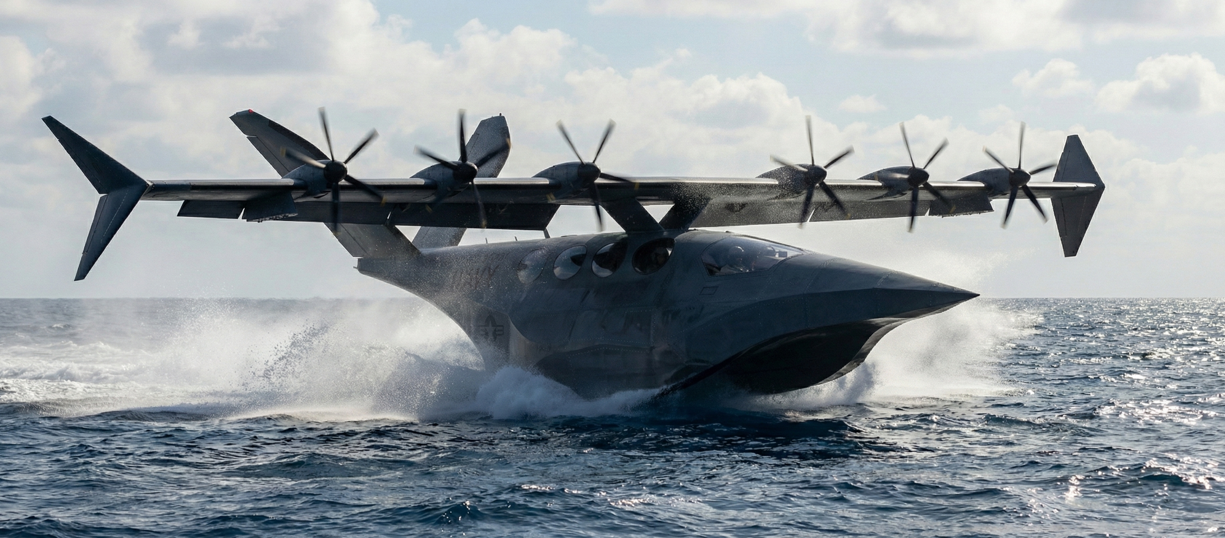
HALO combines maritime hydrodynamics, advanced aerodynamics, and rugged propulsion to remove traditional amphibian drag penalties.
Global reach up to 5,536 nm one-way, up to 50.4 hours loiter, super-STOL water launch in 120-154 m, and multi-fuel capability (Jet-A, marine diesel, SAF).
The geodetic Toray dry-fiber carbon/Kevlar structure with closed-cell foam provides corrosion resistance, ballistic tolerance, and passive buoyancy.
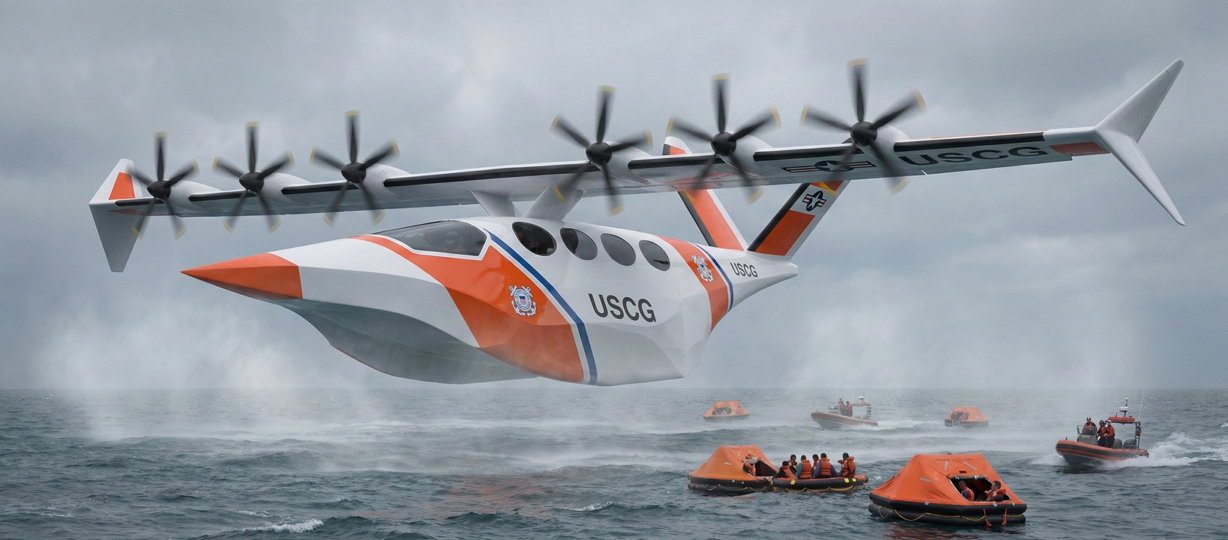
HALO follows a vessel fast-track strategy using IMO-aligned maritime pathways to accelerate market entry and reduce regulatory cost.
The sovereign-financing go-to-market model (including structures such as AIFFP and Japan OSA) reduces end-user capital burden.
Current ask: $25M to complete advanced engineering studies, finalize the Digital Twin, secure the supply-chain consortium, and transition into physical prototyping.